It has been a busy fortnight for the machinery of public-space control, but we begin with a win. The Pilates instructor told she must pay £85 a week to run a free class on the beach is back, after reaching a deal with the council.
Elsewhere: police in Liverpool have used the new protest powers for the first time, drawing a zone on a map inside which covering your face became a crime. Two councils are consulting on renewed Public Spaces Protection Orders, including a ban on making ‘sexual comments’. And in Chiswick, police officers walked into a pub to warn a man about his tweets.
Here is what we have been watching….
The beach Pilates class is back, and what it tells us
Alexandra Beard has run a free Pilates class on Bell Wharf Beach in Leigh-on-Sea on Sunday mornings. More than a hundred people come, and nobody pays: attendees are encouraged to donate to local charities instead.
Southend-on-Sea City Council told her that to carry on she would have to pay £85 every time she used the beach, complete an event application form, produce a risk assessment, provide a first aider and an event management plan, and obtain public liability insurance, around thirty pages of documentation in all.
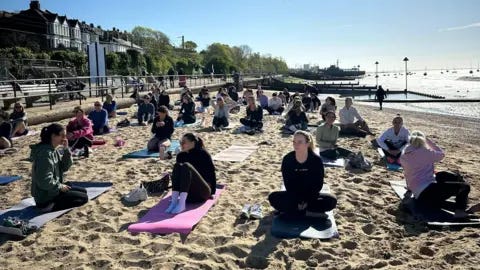
After a public outcry, the council has now agreed that the £85 will be charged once rather than weekly, has helped her with the paperwork, and has acknowledged the ‘community benefit’ of what she is doing. She is back on the beach; she is pleased, and so are we.
But look at what has actually happened. A woman who gathers a hundred neighbours on a beach to stretch, for nothing, needed a permit, a risk assessment, insurance and the personal intervention of a council cabinet member, after a national news story, to be allowed to carry on. That is not a system working; that is a system that failed and was rescued by publicity. BBC News
This is the problem with council ‘events’ licensing – and why it needs to change.
Once you accept that a group of people gathering in a public place is an ‘event’ requiring permission, fees and form filling, the same permission regime lands on the campaign stall, the petition table, the street preacher and the busker, as well as the yoga class.
We have documented what this does to political campaigning: parties and campaign groups told they need a licence, a fee, a risk assessment and public liability insurance to put out a table on the high street. Democratic activity treated as a commercial pitch, and refused if the paperwork is wrong. We are calling on councils to change their policies and allow presumed consent for political campaigning.
- See our report, Gatekeepers – How Councils are Controlling Access to the Public Square
- See our campaign page: Free speech under threat in town squares
Have your say: two PSPO consultations closing now
If you live in, work in or visit Coventry or Greenwich, please respond. Councils routinely report that ‘most respondents supported the order’, and they can only say that if the people who object stay silent.
Greenwich, closes Wednesday 22 July Renewal of orders covering foul and abusive language, threatening or intimidating behaviour, ‘sexual or gender-based comments’, and aggressive or persistent begging. The council says that more than 2,800 fixed penalty notices issued for PSPO breaches between January 2023 and December 2025. It offers this as proof the orders work; we think it is proof of something else.
👉 Respond here (Note: Greenwich requires you to register an account, giving a username, email and postcode, before you can respond.)
Coventry, closes Sunday 26 July A renewal to November 2029, with new restrictions proposed on loudspeakers, microphones, megaphones and other amplification equipment, and on temporary structures including gazebos, stalls, canopies and display stands unless authorised by the council. In plain terms: a permission regime for anyone who wants to speak, sing, preach or campaign in the centre of Coventry. This echoes the measures in Leicester, which we have been opposing with local campaigners for the past year. These restrictions have had a devastating effect on local political life and free speech. We want to stop Coventry going the same way.
👉 Respond here
Our response to Nottingham’s new PSPO: A new planned legal order for the city centre would criminalise charity collection and the sale of the Big Issue in the ‘wrong spot’, along with banning people from sitting or loitering near a public transport stop, and giving council wardens powers to order buskers to stop playing.
Read our response to Nottingham’s PSPO
Police warn a pub regular over tweets about his councillor
Three pubs on Strand-on-the-Green in Chiswick, the Bull’s Head, the City Barge and the Bell & Crown, have put tables by the Thames for decades. Last month Hounslow Council told all three to clear the furniture away, after a licence renewal found that they lacked permission under the Highways Act to place it on the walkway.
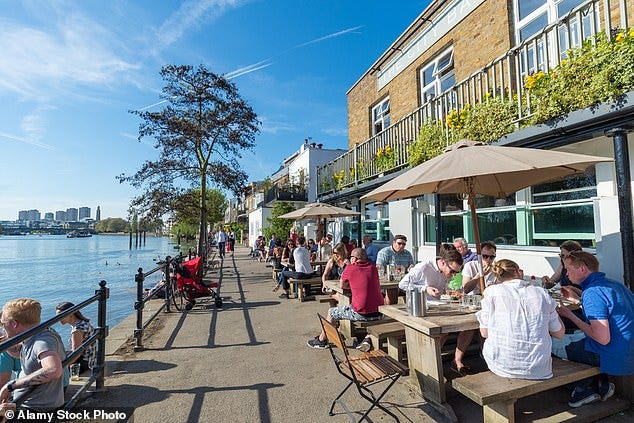
Local people objected, and a photographer, Alastair Hilton, posted about it, and a protest meeting was held outside the City Barge. The council backed down, and the tables are back.
Then two Metropolitan Police officers walked into the Bell & Crown, found Hilton having a drink with a friend, and asked him to step outside. They warned him that his posts about a local councillor could be construed as harassment, while acknowledging on camera that he had committed no offence. Hilton filmed the twelve-minute exchange and it has since been watched by millions.
Two things are worth noting here. The first is a piece of bureaucratic obstruction: decades of harmless use, reclassified overnight as a licensing breach, reversed only because enough people made a fuss. The second is what happened to the man who made the fuss. Effective public objection to a council decision is exactly the kind of speech a functioning town runs on; it should not attract a visit from the police.
Liverpool: new protest powers used for the first time
Ahead of an anti-immigration protest and counter-protest on 4 July, Merseyside Police introduced a ‘Designated Protest Area’ in Liverpool, using powers in Part 10 of the Crime and Policing Act 2026 that came into force on 29 June. Inside a formally designated area, it is now an offence to wear or use anything that conceals your identity, or someone else’s.
The force layered this on top of a dispersal zone, covering a large swathe of north Liverpool, giving officers the power to direct people out of the area and to seize their belongings, including music equipment.
Note what is actually criminalised: not violence, intimidation or disorder, which are already crimes. What is criminalised is covering your face while standing inside an area an officer has drawn on a map. People cover their faces for all sorts of reasons: illness, cold, religious observance, or simply not wishing to be run through a facial recognition system. Under a designated protest area, all of them commit an offence.
The power was five days old when a police force reached for it. Powers granted for the worst cases are always used for ordinary ones, and always sooner than anyone expects.
219 people dispersed from Thanet in two months
Between 1 May and 1 July, police in Broadstairs, Margate and Ramsgate issued 219 dispersal notices requiring people to leave an area or face arrest. Fresh dispersal orders were imposed across parts of Thanet from 2pm on Friday 10 July, timed for a spell of hot weather, with powers to seize items including music equipment.
We have long pressed police for proper information on how they are using dispersal powers, but many forces don’t record this (see our report on the police use of ASB powers). Dispersal notices are pre-emptive powers, used against people who have not actually done anything wrong. Banning someone from their town centre for 48 hours is a serious infringement of their liberty, but police treat it lightly as a ‘handy tool’ to use against people who ‘might cause trouble’. A serious review of dispersal is long overdue.
Latest on the Crime and Policing Act
The Crime and Policing Act 2026 received Royal Assent on 29 April. The first tranche of provisions came into force on 29 June, including the protest powers used in Liverpool and the repeal of the Vagrancy Act 1824.
Two things worth noting:
The Vagrancy Act repeal is not the liberalisation it is being sold as. Rough sleeping is no longer a criminal offence, and that is genuinely welcome. But the powers actually used against people sleeping rough and begging in recent years have not been Vagrancy Act powers: they have been PSPOs, Community Protection Notices and dispersal orders. Those all remain, and are expanding. West Suffolk has just consulted on extending its Haverhill PSPO to prohibit begging. This is not the end of enforcement against homelessness; it is a transfer of it, including to powers that carry large on-the-spot financial penalties.
The big fine increase has not happened yet. The Act quintuples the maximum fixed penalty for breaching a PSPO or a Community Protection Notice from £100 to £500. That provision has not been commenced, and is most likely to happen in the autumn. Neither have Respect Orders, which the government says will be piloted before national rollout.
Thanks to our campaigning, the Act also requires the Home Secretary to issue guidance on the issuing of fines within six months of the Act being passed, a deadline of 29 October 2026. That guidance will address the practice we have documented for years: councils that pay private contractors per fine issued. We will be making a submission to the Home Office, to ensure the guidance is robust.