Political parties and groups will be banned from running stalls at markets run by North Yorkshire Council. This decision comes in a document called ‘Use of Council Land and Buildings by Council Members and Political Groups’, approved on 22 October.
Currently, people will still be able to hold stalls at markets run by parish or town councils, but North Yorkshire council will ‘share its protocol’ and ‘encourage adoption of it’ by all authorities, meaning a de facto ban on political stalls in markets across the region.
Unfortunately, it is increasingly common for councils to ban political parties and groups from holding street stalls. Our research found that only 9% of councils would let people set up a political stall without paying a fee or filling in a form.
Other councils that ban political stalls from their marketplaces include:
- Northumberland County Council – policy is ‘not to allow political stalls on any of Northumberland County Council’s marketplaces (e.g., political parties etc.)’;
- Lancaster City Council ‘would not allow a political party or campaigning organisation to book space on the Charter Market’;
- Derbyshire Dales District Council – ‘Markets are not available for political campaigns’;
- West Suffolk Council – ‘We consider the town centre and market as places for trading and not for politics or religion’.
Other councils prevented political groups from holding stalls on all ‘council property’, which included in some cases the entirety of the town centre. Neath Port Talbot Council said that it allowed ‘charity, community and council-supported events’, but not political parties, while Sunderland Council said that political stalls are prohibited and that it only allowed charitable, ‘uncontentious’ non-profits.
Torfaen Council said ‘the Council’s general position is not to allow stalls of a political nature to be located on its land’. In total, 62 councils (26%) banned political stalls outright on their land, whether streets or markets.
The crackdown on political stalls comes at a great cost. Political stalls are a fundamental part of local democracy: setting up your stall in a public place and pitching your cause to all comers, is an essential experience for anyone involved in politics. You get all sorts: people heckling, someone whose mum just died, someone who disagrees with your party’s stance on x or y, others who agree and sign up.
This experience keeps your feet on the ground and makes you open to different strands of public experience and opinion. It is a long way from internal bureaucratic wrangling within council rooms, or the machinations of a political party, or the media or social media bubble of likes and interviews. It is different too to door-to-door campaigning, where you talk to each person in their home (or nowadays you just carpet their doormat with piles of leaflets, increasing in depth as the election approaches).
I would argue that it is essential for all councillors and all political parties to run regular street stalls. Far from being banned, it should be seen as part of the job – part of touching base with your area and keeping yourself open to public opinion, as well as being prepared to physically put yourself out there.
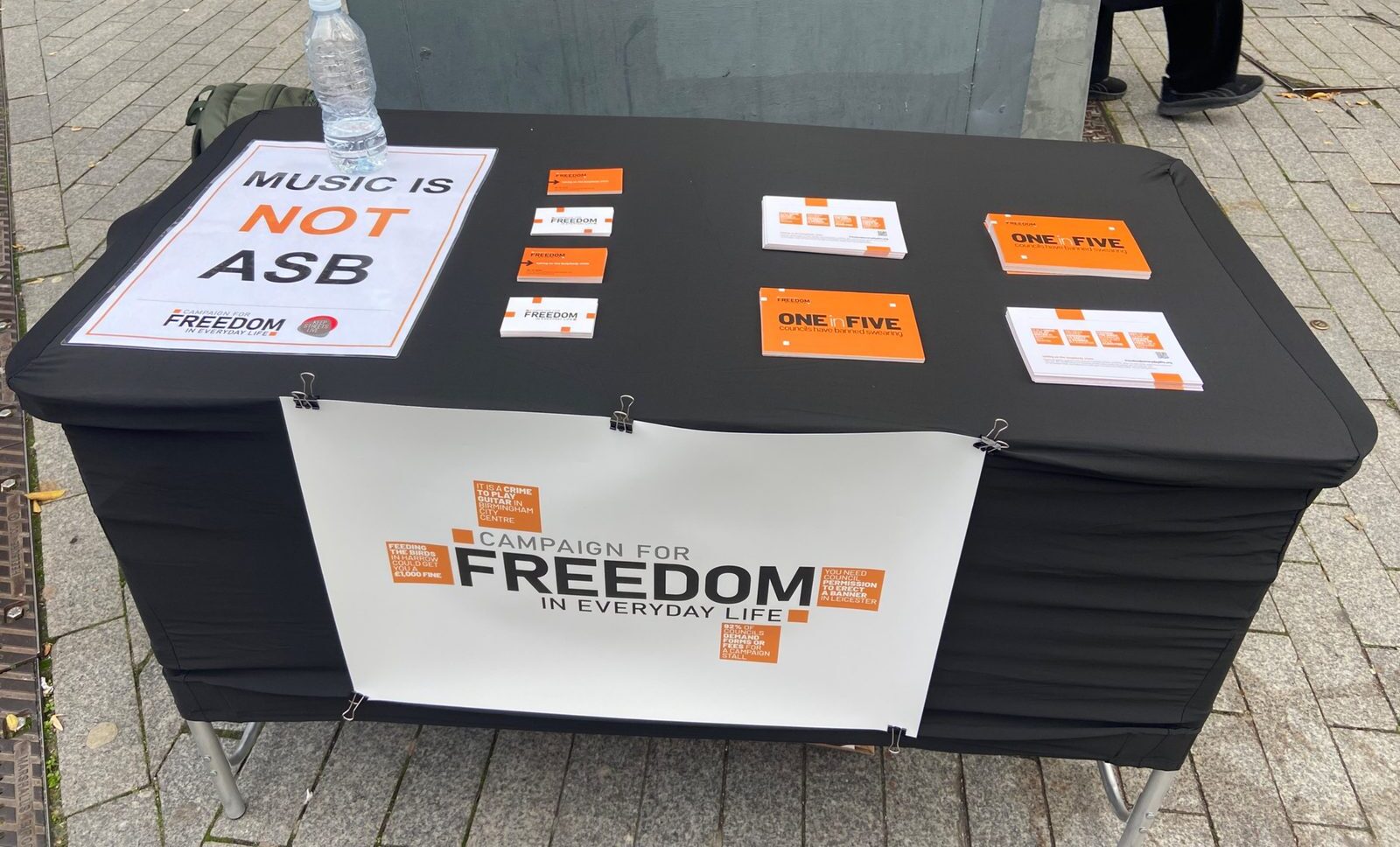
And it’s important to have a stall when you’re campaigning, and not just a clipboard or some leaflets. The clipboard campaigner is always chasing after people; the stallholder is setting out their thing and inviting people over. A stall means people can come to you. You set up a little base, with your literature and banners; you are saying ‘I have something here to pitch’ and people can come if they are interested. The stall can become a little gathering, it can create a hubbub, in a way that a lone clipboard campaigner cannot.
So far from banning political stalls, councils should be opening up markets and town centres and inviting parties and political groups in. Welcoming political stalls is the single thing that could be done to improve local democracy and the relations between councils and their publics.
The North Yorkshire document says that the stall ban is because the council is unable to secure ‘equity of access’ to the markets for all political groups and political parties. This is a common argument made by councils, but it doesn’t make sense. The council doesn’t have to ensure that every political group in the area has the same number of stalls, or a number of stalls proportionate to their size; this would indeed be an arduous and impossible task.
For ‘equity of access’, the council only has to allow political groups equal access to hold a stall, should they want to hold one. This could be achieved simply by allowing markets to be open to all political groups, so people can book on a first come first served basis.