Councils in England and Wales have introduced a swathe of bizarre bans that will turn ordinary people into unwitting criminals. Councils have used Public Spaces Protection Orders (which allow them to ban any activity they judge to have a ‘detrimental effect on the quality of life’) to introduce over 1000 new laws, each of which can contain dozens of separate restrictions.
These orders are not subject to democratic or legal scrutiny: they can be brought through by a single unelected council officer, and do not require public consultation or full council assent.
PSPOs were intended to target serious anti-social behaviour, but our research finds that these powers are being used to ban actions such as picking up stones, shouting, feeding birds, and sleeping in public.
One notable finding is the explosion of restrictions on free expression, with 1 in 5 councils now banning swearing, shouting, gestures, or certain kinds of language. In 2022, only 16 councils used PSPOs to regulate language in public spaces – now the figure is 61.
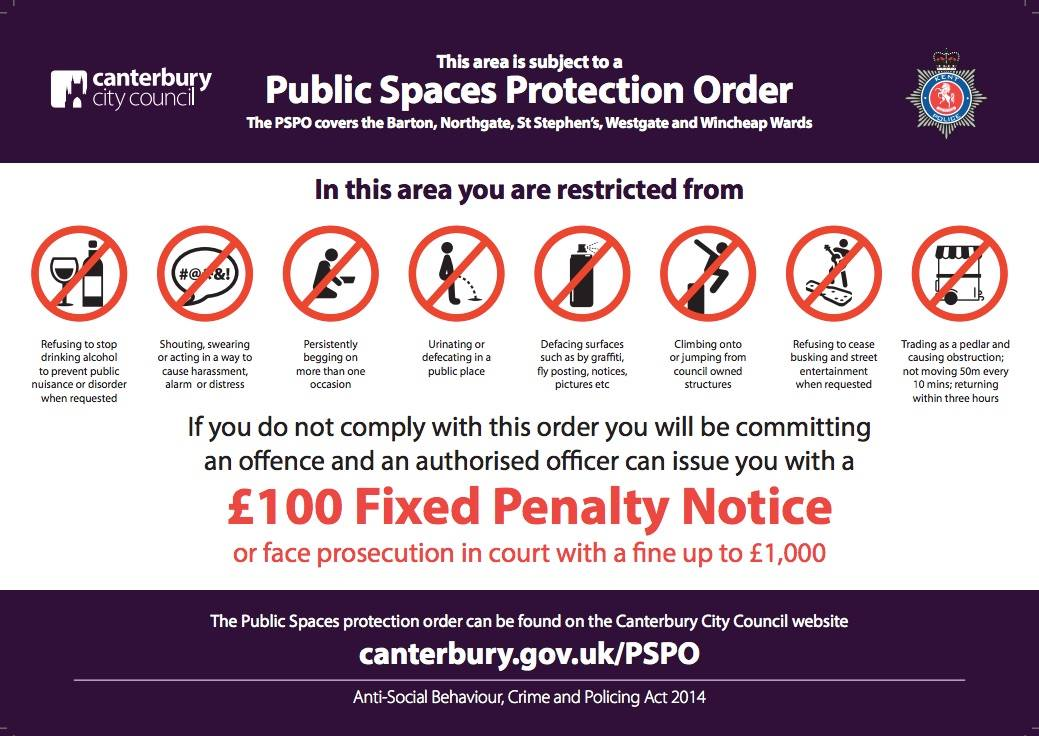
We are calling for these powers to be reformed, to ensure that they are subject to democratic scrutiny in full council and with easily accessible rights of appeal (currently the only appeal is through the High Court, which is extremely expensive). Reform is necessary to ensure that PSPOs are used proportionately and only in cases of serious anti-social behaviour, as required by Statutory Guidance.
What has been banned?
We issued an FOI request to 319 councils in England and Wales, and received responses from 297. Of councils who replied, 271 (91%) had at least one PSPO in place; only 26 (9%) did not have a PSPO. Together, councils had 1268 orders in place, each of which included up to 30 separate restrictions. Here is a ranked list of the subjects of council PSPOs, showing the number of unique councils who have issued an order targeting any particular activity.
Based on 297 councils who replied to FOI request, ranked by frequency
| # | Activity | Councils | % |
|---|---|---|---|
| 1 | Alcohol | 171 | 57.6% |
| 2 | Dog control | 130 | 43.8% |
| 3 | Begging | 59 | 19.9% |
| 4 | Music/radio (causing nuisance) | 45 | 15.2% |
| 5 | Intoxicating / psychoactive substances | 42 | 14.1% |
| 6 | Loitering | 40 | 13.5% |
| 7 | HAD (harassment, alarm or distress) | 37 | 12.5% |
| 8 | BBQs | 36 | 12.1% |
| 9 | Tents / camping | 34 | 11.4% |
| 10 | Limitation on number of dogs | 34 | 11.4% |
| 11 | Means to pick up | 31 | 10.4% |
| 12 | Cycling | 31 | 10.4% |
| 13 | Congregating / groups | 30 | 10.1% |
| 14 | Fires / open fires / naked flame | 29 | 9.8% |
| 15 | Amplification/loudspeakers | 20 | 6.7% |
| 16 | Skateboarding | 18 | 6.1% |
| 17 | Spitting | 16 | 5.4% |
| 18 | Anti-social / nuisance / intimidating behaviour | 14 | 4.7% |
| 19 | Fundraising/charity collections | 14 | 4.7% |
| 20 | Feeding (animals/birds) | 13 | 4.4% |
| 21 | Busking/street entertainment | 12 | 4.0% |
| 22 | Face coverings | 11 | 3.7% |
| 23 | Bins on street / bin noncompliance | 10 | 3.4% |
| 24 | Dogs on beaches | 10 | 3.4% |
| 25 | Fishing/angling | 9 | 3.0% |
| 26 | Swimming/jumping into water | 9 | 3.0% |
| 27 | Leafleting/free literature | 9 | 3.0% |
| 28 | Throwing items | 7 | 2.4% |
| 29 | Fireworks | 7 | 2.4% |
| 30 | Lying/sitting | 6 | 2.0% |
| 31 | Catapults | 6 | 2.0% |
| 32 | Sleeping/rough sleeping | 5 | 1.7% |
| 33 | Climbing on structures | 5 | 1.7% |
| 34 | Whistling/catcalling | 4 | 1.3% |
| 35 | Ball games / games on highway | 4 | 1.3% |
| 36 | Removing/displacing stones | 3 | 1.0% |
| 37 | Metal detectors | 3 | 1.0% |
| 38 | Golf | 3 | 1.0% |
| 39 | Exercise/fitness classes | 2 | 0.7% |
This shows that, while alcohol and dog control restrictions are still the most common, 1 in 5 councils now ban begging, and there are widespread bans on playing music/radio in public (15% of councils) as well as bans on loitering (13.5%). 30 councils restricted congregating in groups, 20 councils banned amplification, 13 councils banned feeding the birds and 11 councils restricted face coverings.
Most notably, 61 councils now restrict freedom of expression, with a rapid growth in bans on swearing, shouting, and restrictions on particular gestures. 53 councils (18%) restricted swearing or foul language in some form. This represents a significant growth from 2022, when only 16 councils imposed such restrictions.
Based on 297 councils who replied to FOI request
| Restriction | Councils | % |
|---|---|---|
| Foul/offensive language | 28 | 9.4% |
| Swearing | 17 | 5.7% |
| Shouting/screaming | 16 | 5.4% |
| Verbal abuse | 13 | 4.4% |
| Sexual comments/language | 11 | 3.7% |
| Sexual/offensive gestures | 6 | 2.0% |
| Language causing HAD (harassment, alarm or distress) | 2 | 0.7% |
| At least one restriction on expression | 61 | 20.5% |
Here is a selection of the PSPO texts:
| Council | Restriction (extract from PSPO text) |
|---|---|
| Redditch Borough Council | “No person shall use any threatening, abusive, obscene or offensive language or behave in a disorderly, indecent or offensive manner likely to cause harassment, alarm or distress within the restricted area.” |
| Guildford Borough Council | “Intentionally shouting or screaming. Using foul, abusive or threatening language.” |
| Leeds City Council | “Verbal abuse, swearing or intimidation to members of the public… make verbal insults, including sexualised comments and gestures.” |
| Waverley Borough Council | “Intentionally or recklessly, shouting, swearing, screaming, being verbally abusive or acting in a manner that a reasonable person would think would cause, or likely to cause, harassment, alarm or distress.” |
| Dartford Borough Council | “Swear, shout, or act in a threatening manner.” |
| Redbridge London Borough Council | “No person shall verbally abuse, harass, or behave in any way towards other persons in a manner which is of a sexual nature, and which causes or is likely to cause them or persons present, harassment, alarm, or distress. This will include, but is not limited to, asking if they are for hire, and making sexually inappropriate comments or gestures.” |
| Enfield London Borough Council | “Engaging in Public Street Harassment such as: catcalling (e.g., whistling, making sexual comments), staring or leering.” |
| Kirklees Council | “Shouting, or unsolicited sexualised or offensive comments or gestures, catcalling from vehicles is prohibited.” |
| Huntingdonshire District Council | “Behaviours include, but not limited to: aggressive shouting at any person; any offensive language; physical altercation; street harassment (heckling or cat-calling passersby)” |
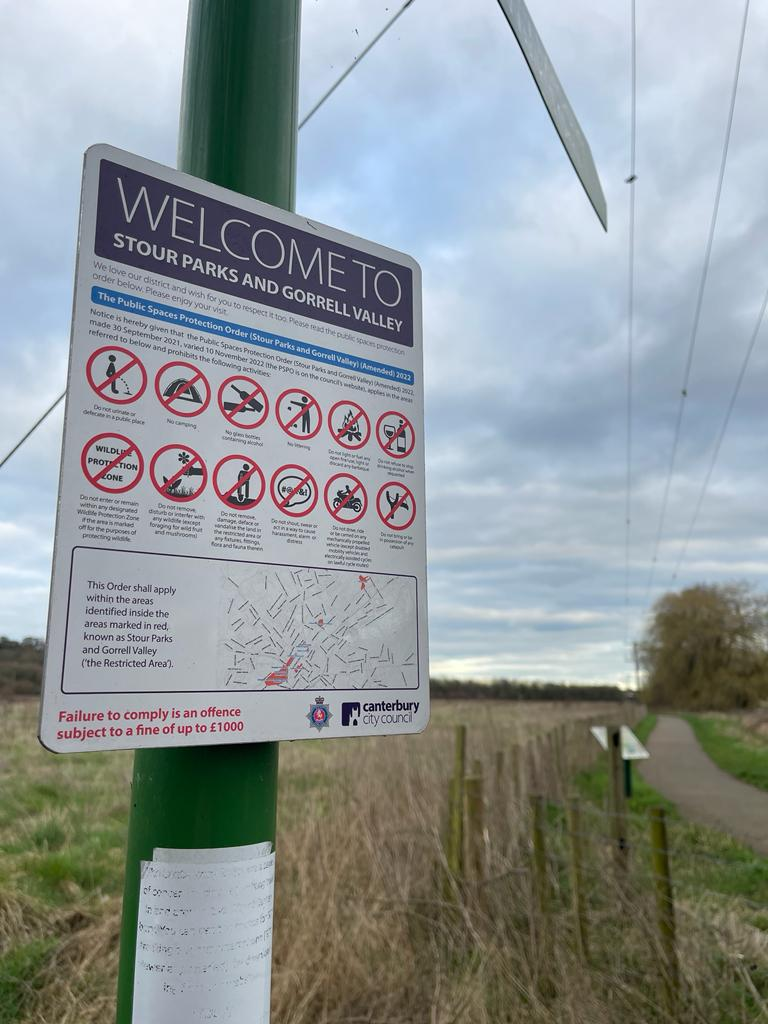
These restrictions on freedom of expression are not only applied in urban areas; for example, Canterbury Council erected signs banning ‘shouting’ in the open countryside:
In other individual restrictions, Burnley introduced a curfew for under 16s of 11pm (and under 14s of 9pm). Cornwall Council introduced a ban on ‘loitering for the purposes of hair braiding or applying henna tattoos’ in St Ives, while North Somerset council banned people from petitioning or asking for signatures on the property of Weston-Super-Mare Museum.
What is the problem with these orders?
Here is a summary of the problems with these orders:
1. Targeting everyday activities
PSPOs often target acceptable and ordinary activities, which do not cause others harm. This includes the 13 councils restricting feeding birds, which led to a woman being arrested in Harrow earlier this year. Several councils restrict sitting or lying on the ground, or sleeping in public, which would make it a crime not only to be homeless, but also to have a nap in a park. For example, Rother Council’s order states:
No person shall sleep or deposit any materials used or intended to be used as bedding in any public space within the restricted area, being the entire Rother district.
At least three councils would make it a crime to pick up stones or rocks: Torbay Council bans removing rocks from a coastal area, while Richmond upon Thames bans removing or displacing ‘any stone, soil or turf’, and Rugby Council bans removing ‘soil, sand, shingle or rock’.
And three councils would make it a crime to pick blackberries: Harrow Borough Council bans ‘any foraging for fungi, or fruit, flowers or other plant material’; Richmond upon Thames bans removing ‘any plant, shrub or tree… without the express prior consent of the Council’; and Rugby Borough Council bans removing ‘a tree, shrub, fungus or part thereof’ (Rugby also bans people from climbing trees).
New countryside restrictions would ban many wholesome and customary ways of enjoying the outdoors. 29 councils have introduced restrictions on fires: many of these would prevent the responsible use of camping stoves from substantial areas of countryside, and indeed 12 ban any ‘naked flame’ at all, which would prevent matches and lighters.
There are also bans on wild swimming, including in whole districts – North Lincolnshire’s order states ‘No entry into open water, for the purposes of diving, jumping, paddling or swimming, by any person within North Lincolnshire’. Meanwhile, Pendle bans anyone from ‘stepping on to or otherwise placing their weight upon any frozen waterway’.
2. Targeting pro-social behaviour
Orders often target activities that are explicitly pro-social: where people are trying to contribute to their local area and connect with others. 29 councils restrict busking and/or amplification, which would make it impossible for people to speak to a crowd or to busk in a public place. Birmingham City Council bans not only amplified busking, but all unauthorised ‘noise’ in the city centre:
A person is prohibited at all times from using amplification equipment, musical instruments or other items used as musical instruments within the restricted area. This includes but is not limited to: Noise associated with busking, street entertaining, street preaching and public speaking
One of these orders led to the fining and arrest of 17-year old Charlie Wilson, a Britain’s Got Talent contestant who was busking in Bury. The local paper had run an article calling him a ‘talented street singer’ who was ‘putting a smile on shoppers’ faces’ – but he was handcuffed by police and forced to give his details so he could be issued with a penalty notice for breaching the PSPO ban on amplification. He asked police officers: ‘to cheer people up, is that a crime now?….Everyone’s enjoying it, people are sitting down and watching’. While he was being arrested, members of the public came up say ‘we were enjoying that’, with one mother saying ‘it’s my little girl’s birthday and you just made her day, it’s absolutely gorgeous, thank you for making her day’.
Here, an activity that was being celebrated and enjoyed by the public – people were sitting around and watching, he was making their day – was targeted as ‘anti-social’ and restricted.
Similarly, bans on political campaigning target those who are seeking to connect with fellow residents and make a difference to their area.
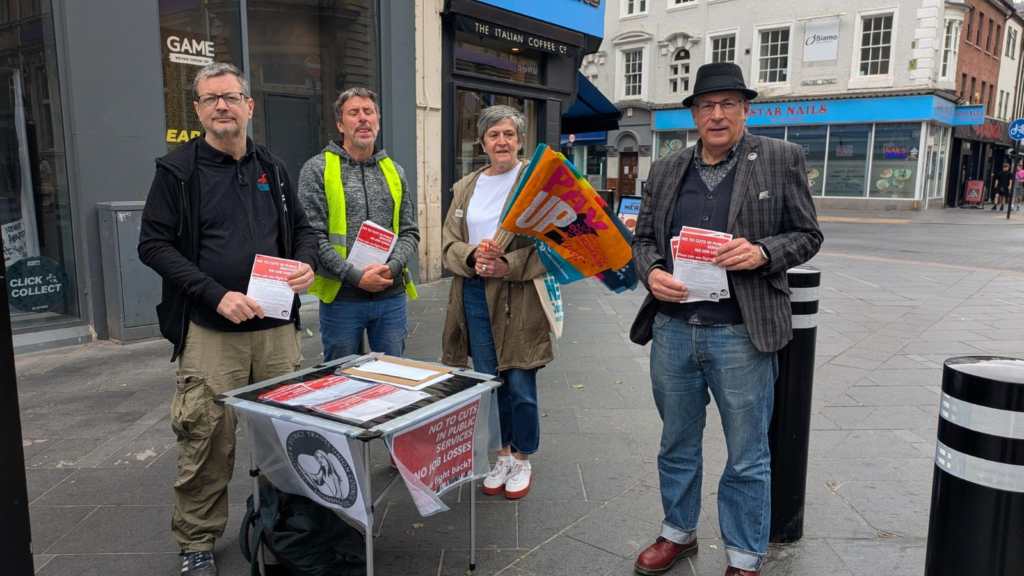
Leicester City Council has banned anyone from displaying flags, banners, or putting up campaigning stalls, without its permission – an order that has been opposed by political activists, who have held protests, and revealed that it was impossible to gain council permission to campaign. A pensioner was among the eight people fined in 2025 for the offence of campaigning in public or displaying a banner without council permission.
3. Vague offences that give officials too much power
It is notable that many of the orders create extremely broad offences, and invest wide power in council officers to decide whether somebody is committing an offence or not. For example, Coventry’s PSPO bans
the congregation of groups of 2 or more persons…where the behaviour of some of all members of the group has or is likely to have a detrimental effect on the quality of life of those in the community
Pendle Council bans
causing or likely to cause a nuisance or annoyance to anyone else in the park or the locality by way of (including but not limited to) shouting or singing; use of a musical instrument or use of a radio; smartphone; tablet or any other device capable of playing amplified music
North Lincolnshire Council states that ‘A person must not cause a noise disturbance in a public place which is deemed by an Authorised Officer to cause harassment, alarm, or distress to any other person’.
Crimes such as loitering or begging give wide latitude to officers to decide if someone has fallen foul of the law. For example, Welwyn Hatfield District Council includes the act of sitting as an implied request, banning ‘Sitting on the ground in a public place, street, highway or passage in a manner that may be perceived that you are inviting people to give you money’.
Epping Forest District Council defines loitering to include sitting without an obvious reason: ‘The term ‘loitering’ shall include the actions of standing, sitting, or lingering (i) aimlessly or without an obvious reason; or (ii) for the purpose of begging, drug taking, or drug dealing. Any person sitting or loitering on the highway or any pedestrian area of the Restricted Area demanding or begging or perceived to be begging by an authorised person’.
Blackpool Council bans loitering, defined as ‘standing, sitting, approaching people they do not know or waiting around without apparent purpose’, and employs a non-exclusive definition of begging: ‘Begging is not limited to approaching people and/or asking for money, food or other things, or placing a receptacle for donation’.
Several councils criminalise the causing of ‘annoyance’. Gosport Council’s PSPO states that ‘No person shall loiter, sit or lay on the floor…in a manner causing or likely to cause harassment, alarm, distress, nuisance or annoyance to any person’. Lancaster City Council prohibits: ‘No person or groups of 2 or more persons shall allow their actions to cause annoyance, harassment, alarm or distress to any person within the Designated Area or on land adjacent to the Designated Area or to any person living nearby.’
Kingston upon Thames creates ‘a general prohibition on anti-social behaviour within the Restricted Area where it causes, or is likely to cause, nuisance or annoyance to any other person’, while Bassetlaw Council’s order states that ‘No person shall shout, swear or act in a manner as to cause nuisance, annoyance, harassment, alarm or distress to any person within the Designated Area’.
These broad bans on causing annoyance mean that the officer is placed in a position of being able to decide who should be punished, since almost everything everybody does could be potentially annoying to someone.
A number of councils have created new offences of ‘anti-social’ cycling, driving, or parking, which give officers latitude to decide what qualifies as this offence (these not being established offence categories). For example, Guildford Council bans the use of wheeled toys ‘which an authorised person believes to be….anti-social’, while Redcar Council bans cycling ‘in an inconsiderate manner’.
Other councils have given their officers broad powers to order someone to stop their activity (such as busking or cycling), or to leave an area; it is a crime for the person to refuse. For example, Amber Valley Council gives powers to officers to order a person to dismount a cycle if they believe they are ‘riding in a malicious manner’.
How are these orders enforced?
The main enforcement of PSPO violation occurs through the issuing of a fixed penalty notice, by council or sometimes police officers. Our previous FOI research found that in 2025, over 25,000 penalties were issued, which is a record high. The Crime and Policing Bill – currently finishing its passage through parliament – will increase penalties for PSPO breach from £100 to £500, meaning that the vague and absurd laws outlined above will now mean a substantial penalty for those who violate them.
Still worse, our research finds that 75% of these PSPO breach penalties are given out by private companies who are paid per fine, and therefore have an incentive to issue as many fines as possible. These companies are responsible for many of the fines issued for offences such as feeding birds, standing in groups, cycling in the town centre, and swearing.
For example, Boston Council (which employs Kingdom LA Support) issued 37 penalties to people for feeding the birds, while North Somerset (which employs Kingdom) issued 7 penalties to people for swimming. Bedford (which employs District Enforcement) issued 619 penalties to people for cycling in the town centre and 4 to people for skateboarding. Greenwich (which also employs Kingdom) issued 98 penalties for ‘abusive language’, 7 penalties to people for loitering near a cash machine, two for ‘obscene gestures’, three for amplification, and 316 for ‘driving or riding’.
Overall, the 31 councils employing a private company issued 19,214 FPNs, including 10,517 in Hillingdon (which employs the company APCOA) and 3,143 in Harrow (Kingdom Security). The 251 councils not employing a private company together issued 6,152 FPNs. This means that people were on average 25 times more likely to be fined if their council employed a private company than if their council did not.
However, the data on FPNs is only a part of the story. Evidence suggests that by far the biggest impact of PSPOs is through informal warnings, with officers moving people on or stopping them from carrying out an activity. The PSPO is used as a threat – a means to order someone to change or stop their activity – rather than something that is consistently enforced. It is this that explains the sometimes small number of fines for offences that are so broad they must have been broken many hundreds of times. For example, some councils with bans on shouting have not issued any penalties; it is inconceivable that nobody would have shouted or sworn in a city in the course of a year.
Data from Middlesbrough Council on PSPO ‘interactions’ shows that FPNs are the tip of the iceberg of enforcement. ‘Interactions’ include formal and verbal warnings by officers for someone to desist their activity: in 2024 and 2025, the council counted 1098 ‘interactions’, yet in this period issued only 13 FPN penalties. (Interactions included 249 people disciplined for verbal abuse and 656 people disciplined for begging.) The radio of ‘interaction’ to FPN is 84.5 to 1. If the rest of the country exhibited a similar ratio, this would mean that 2.1 million people have been stopped from carrying out an activity under these powers, suggesting interference in public freedoms on a massive scale.
Similarly, research from Sheffield Hallam University indicates that the primary use of PSPOs for homeless people is to move them from an area – sometimes several times in one night – rather than to issue FPNs. (In Middlesbrough, three homeless people were disciplined in 2023 for the offence of rummaging in bins). PSPOs targeting homeless people are primarily used as a means of coercion by police and council officers, rather than being enforced consistently through penalties or prosecution. The effect on public freedom is no less profound, although it is harder to document or hold to account.
Conclusion and recommendations
This research shows that the use of ‘anti-social behaviour’ powers is not in practice being used to target serious anti-social behaviour. In many cases, these laws target actions associated with poverty or homelessness (as with bans on loitering, begging or rough sleeping). In other cases, they target ordinary everyday actions; or even pro-social behaviour, such as busking or campaigning, which are seeking to connect with (and bring enjoyment to) fellow residents.
It is our view that in practice the category of ‘anti-social behaviour’ increasingly lacks consistent or objective meaning. Instead, it increasingly has a fluid meaning, and is often employed to mean any activities of which certain officials disapprove. ‘ASB’ can therefore include unlicensed busking – even if busking is bringing great enjoyment to those in the locality – or anything that has not been authorised by the council, such as the display of flags or banners.
As a counterbalance, it must be said that many councils have been remarkably restrained in using these broad and unchecked powers. It is notable that in 2025, 45% of councils did not issue any penalties for PSPO violation. Councils have been given the power to create the most absurd laws, passed by a single officer, and then to contract a private company to issue penalties on commission. The fact that most councils have not exploited this to the full is testimony to the persistence of a sense of proportionality and public service within many local authorities.
However, powers to punish should not rely on the restraint of officials; rather, restraint and proportionality should be required as a condition for the use of these powers. Therefore, reform is urgently required, to ensure that these powers target only harmful actions and are used proportionately and in the public interest. Here are our recommendations:
1. PSPOs should only target activities causing significant nuisance or harm
The Statutory Guidance states that ‘the council should give due regard to issues of proportionality: is the restriction proposed proportionate to the specific harm or nuisance that is being caused? (C)ouncils should ensure that the Order is appropriately worded so that it targets the specific behaviour or activity that is causing nuisance or harm and thereby having a detrimental impact on others’ quality of life’. It is clear from the survey above that this requirement is often not followed: instead, PSPOs are drafted as ‘catch-alls’ to allow officials to intervene in a wide range of circumstances, many of which do not involve any nuisance or harm.
2. PSPOs should pass through full council and be subject to democratic scrutiny
The Statutory Guidance recommends that ‘the close or direct involvement of elected members will help to ensure openness and accountability. This will be achieved, for example, where the decision is put to the Cabinet or full Council’. The same recommendation is made by the LGA in its guidance. However, in practice this very rarely happens: in one survey, only 16% of councils passed the order through full council. We recommend that full council be made a general rule – ideally in primary legislation – in order to ensure that these laws are subject to full democratic scrutiny.
3. There should be an accessible appeal mechanism
The current appeal system through the High Court is prohibitively expensive and performs no role of checking the use of the power. There have only been a handful of appeals in 12 years, which were mainly financed by US pro-life groups; this is not therefore an appeal system that functions for local people.
There needs to be a system whereby PSPOs can be easily and cheaply appealed by local groups or interested individuals. This could be a magistrate’s court appeal (where the appellant is not liable for council costs) or appeal through a council committee that is open to the public. A regularly used and cheap/free appeal system will ensure that the power is subject to regular checks, that statutory guidance is followed, and that members of the public gain rights and formal input into the operation of this power.
4. Fining for profit should be banned for PSPO offences
Currently 75% of PSPO breach penalties are issued by private enforcement companies that are paid a portion of every fine issued. This creates a direct incentive – and financial necessity – for them to issue as many fines as possible. There should be a prohibition on ‘fining for profit’ for PSPO offences, introduced into the primary legislation or failing that into the statutory guidance.
The Liberal Democrat peer Tim Clement Jones introduced a series of amendments to the Crime and Policing Bill, seeking to ban fining for profit for PSPO offences. These amendments have all passed with support from the Conservatives and regional parties. It is surprising Labour has been the only party opposing these amendments. The government has been forced to concede that it will introduce changes to the Statutory Guidance, which will specify that
Where external contractors are used, private firms should not be able to receive greater revenue or profits just from increasing the volume of penalties.
It is essential, however, that there is a mechanism for enforcing this specification, either through appeal of FPNs in court or through formal appeal to the council.