Introduction
Across the country, people gather in the mornings and at weekends for outdoor community sport – yoga, workouts, qigong, or swimming, in parks or on beaches. These groups are generally small and run for free or small contributions, and make little or no money. Yet they mean a great deal to those who take part, who are able to meet others and exercise in nature or in local open spaces.
However, increasingly councils are demanding that people pay fees and fill in application forms in order to organise outdoor community sport. This is a new development, although councils might be using old byelaws to do it. It is novel that local authorities would classify a few people doing yoga as a formal ‘event’ (requiring the same authorisation as a music festival with toilets and stages), or as requiring a parks, seafront or trading licence (as would an ice-cream van).
We were alerted to this development by the case of Alexandra Beard, who held a free Sunday morning pilates class on the beach at Leigh-on-Sea in Essex. Her local council demanded 30 pages of paperwork, including an event application form, a risk assessment, event management plan, public liability insurance, a first aider on site, plus £85 per week. After we posted about this case, we were contacted by other members of the public and more cases surfaced.
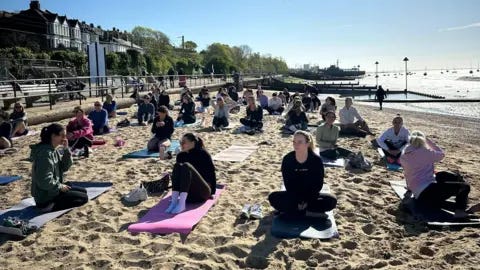
Bristol Council is currently introducing a parks and downs licence scheme that will mean that qigong teacher Chloe Broomby, who runs a class for 1-7 people on a voluntary contribution basis on the downs, will have to pay £900 a year. Julia Turner, who runs the BYOB (Bring Your Own Baby) Choir for mothers and babies in Bristol parks, will have to pay £400 a year. Ailie Tam, who ran ‘tree to tree yoga’ – including forest bathing and yoga, often only for 2-3 people – would have to pay £700 (reduced to £350 only because of her income bracket), because the session involved walking between two parks.
Angela Brier-Stephenson, a yoga teacher in Westgate-on-Sea – who met at 6am for 45 minutes, with a maximum of 10 people paying a voluntary donation – was asked by Thanet Council to pay £1,400 for the season to use the beach.

These rules are having a heavy cost. Angela hasn’t run her yoga class for two summers, since the rules came in. Alexandra had to move her class to a cafe, which only fit around 12 people, rather than the usual 100-150 who would gather on the beach. (She was only allowed back on to the beach after the council gave her a fee reduction and imposed a numbers cap). Many Bristol groups have either stopped their activities or are doing so quietly under the radar, hoping they will not get stopped by council officials.
Of course, if somebody is organising a large-scale commercial event in public spaces, they should have to apply in advance and pay a fee. But these low-key community gatherings involve people turning up and putting their bags down wherever there is a spot; they don’t have toilets or stalls or food and drink. These classes are often run on a shoestring, because the person running them feels they have something valuable to offer, and they can be immensely important to those who take part.
In blocking these gatherings with red tape, councils are taking away something very valuable. Outdoor exercise classes offer free or low-cost exercise, precisely because there are no overheads – no venue hire or bills. Several organisers told me that they wanted everyone to be able to come, whatever their financial means. Helen Wilson from Swansea ran her beach yoga classes on a donation basis, so that ‘the people most in need in the community can access the event’. Chloe in Bristol said that ‘if somebody couldn’t afford it at all, I’d still like them to come’ to qigong.
These events also a sense of connection between members of a community and a public space. Often it is the organisers of these classes who also clean up litter and help to manage parks and open spaces on a voluntary basis. The Bristol yoga teacher Ailie (who has stopped her yoga classes because of the parks fee) is also part of the park’s Friends group, cleaning and managing that public space and donating two trees to the park: ‘I collect the litter, do the bulb planting, as well as the hours of volunteering I’ve been doing for years.’
The crackdown on outdoor exercise is part of a larger trend. Increasingly, councils are treating all kinds of informal gatherings as official ‘events’, requiring form filling, risk assessments and fees. We have previously identified this in our work on political stalls, where 92% of councils either banned political stalls or required people to apply and pay a fee beforehand.
Councils are interfering in – and restricting – everyday community activities, meaning that the valuable role of these activities for health, social connection, and democracy is being lost. The result will be that only highly professionalised or commercial groups will be able to use public space. Mass boot camp events or a commercial product stall would be able to carry on, but tree yoga or a local campaigning group would not.
We are calling for a blanket exemption for small-scale community activities from parks and other licence schemes. Asking a qigong class of four people, run on a donation basis, to pay an annual licence and have a first aider on site is wildly disproportionate and counter-productive.
There needs to be a return of common sense – and a recognition of the value that these groups bring to local areas and to public health and happiness.
The history of regulation
Councils began charging for outdoor exercise in the early 2000s, focusing on personal trainers and bootcamps. A Radio 4 survey in in 2012 found that a third of councils charged personal trainers for using parks: at the time, PTs complained that charges were too high, and they had to pass the cost on to the client, making exercise more expensive. In the past few years, some councils have started extending these regimes to yoga classes and other community events, including donation-based or free activities.
In Swansea, Helen Wilson ran her donation-based beach yoga class for about a decade, before the council emailed her in 2025 saying that a fee would now apply. In Thanet, the council had helped to fund free yoga classes in 2023 and 2024 – but then in 2025 told these same groups they would have to pay over £1000 a year to use the beach. Meanwhile, when Bristol first announced its parks licence scheme in 2021, it said that non-commercial groups would pay only a ‘nominal fee’ – but then by the time the scheme was implemented in 2025-6, a donation-based qigong class was asked to pay the same amount as a commercial fitness class.
Which classes have been affected?
We have carried out a number of interviews with members of the public who have been affected by these rules, which are summarised below, along with cases identified in local press reports. These include free exercise classes in Waltham Forest, open-water swimming in Thanet, beach yoga in Swansea, beach pilates in Southend, and qigong, choir and yoga classes in Bristol.
| Location and class | What the council asked for | In their own words | What happened – effect of the rules |
| Bristol – donation-based qigong on Clifton & Durdham Downs (Chloe Broomby) | £900 a year licence (for sessions under 19 people) on the Downs, charged on the class’s maximum capacity regardless of how many turn up – even though it is donation-based (“pay what you can”) and sometimes just one person attends. If there are more than 20 people, the annual fee is £2,600. | “I don’t take up hardly any space. You can barely see a footprint… it’s there for an hour and then walking off again. It’s not affecting anybody.” | She stopped publicising the class and says she will not be able to hold classes if forced to pay – ‘I wouldn’t be able to’. |
| Bristol parks – BYOB (Bring Your Own Baby) mother-and-baby choir (Julia Turner) | Fee is £400 plus VAT (£200 in the discounted band); plus public liability insurance, a risk assessment, and ‘a first aid certificate for singing in a park’. | ‘I object… it’s obliterating people who couldn’t afford it and would not be able to’.(The sessions were described by mothers as ‘a lifeline’.) | Staged a flash-mob singing demonstration inside City Hall. She has been ‘stalling payment’ and has been ‘indirectly threatened with court action’ by the council. |
| Bristol parks – “tree-to-tree” yoga / forest bathing for often just 2–3 people, walking between parks (Ailie Tam) | Around £600 plus VAT – she would need two licences because she moves between two parks – to run niche yoga for often just two or three people. | ‘We have lost all our common land, we’ve lost our places to gather and connect to the land.’ | Stopped classes – ‘that wouldn’t cover how much I would make’. |
| Southend-on-Sea – free beach Pilates, 100–150 people, donations to charity (Alexandra Beard) | £85 per week plus an admin charge, and around 30 pages of paperwork – an event application, event management plan, risk assessment, public liability insurance and a first aider on site. | ‘I can’t afford £85 a week for a free class.’ | Moved to a cafe that fit only about 12-14, leaving roughly 100 people unable to attend; after publicity the council agreed a one-off fee and ‘adjusted’ numbers, and classes returned to the beach. |
| Swansea – donation-based beach yoga, up to 80 people (Helen Wilson) | £24.15 per session – for a class run on donations that average about £2, with many paying nothing. | ‘Doing it on a donation basis means that people on low incomes can come – the people most in need in the community can access the event.’ | Refused to pay and won an exemption – but on the strict condition that she cannot charge; her donations have since fallen so that she is often not redeeming her basic costs, which she says ‘could threaten the future of the event’. |
| Thanet, Westgate-on-Sea – free / donation ad hoc 6am sunrise beach yoga, about 10 people (Angela Brier-Stephenson) | Roughly £1,000 licence plus a £380 ‘estate’s fee’, for a free, weather-dependent class of maybe 10 people. Also, risk assessments, first aid and instructor qualifications required. | ‘One part of the council [is] trying to encourage local instructors… on the other hand, they’re just trying to block, block, block – it’s just a money-making scheme.’ | Has not run the class for two summers. Her emails to the council – asking what was the basis of the ‘estate’s fee’, and also pointing out that the beach was tidal and therefore not council land – were ignored. Rather than back down, the council expanded the scheme (with zoned pricing) for 2026. |
| Thanet – open-water swimming coaching, in the sea (Vanessa Vajana) | About £1,000 for annual licence plus £380 admin – in effect, to walk across the beach to reach the water, even though her coaching takes place in the sea. | The licence does ‘nothing more than allow me to walk across the sand to reach the water’. | Said the fees made her business unsustainable and she would have to stop operating independently |
| Waltham Forest – free outdoor fitness classes, 11,000+ registered participants (Our Parks, founded by Born Barikor) | £25 per class (about £5,000 a year) for classes that are free to attend. | ‘We do not charge nor profit from the classes.’ (Born Barikor) | Classes suspended; one instructor, Leah Jung, was stopped mid-session by two park rangers. The fee stood; the free model survived only because Our Parks secured external grant funding. |
| Bristol – Let’s Walk, a community walking group working with people who are not traditional park users | A parks business licence fee under Bristol’s scheme – the same scheme that covers choirs and fitness classes. | Kate Spreadbury, of Bristol Parks Forum, warns that small, not-for-profit community-benefit groups are disappearing and that the policy ‘is now doing real harm’. | Can no longer afford to lead walks in Bristol – though they could do so free of charge in a neighbouring authority that does not charge. |
Which powers are councils using?
Councils are using a number of different legal mechanisms for the imposition of these fees and restrictions.
- PARK BYELAWS – these are old powers being used in a new way. Byelaws made under Public Health Act 1875 s.164 and Open Spaces Act 1906 ss.12 & 15 generally require ‘the consent of the Council’ to ‘provide or offer to provide any service for which a charge is made’ or to ‘hold or take part in any public show or performance’. Historically these clauses targeted classical trading and spectacle (hawkers, stalls, fairs, circuses); they were not generally used for small gatherings until recently.
- COMMERCIAL LICENCE/PERMIT. Councils grant a landowner licence to occupy parkland, and attach a fee. The charging powers are Local Government Act 1972 (management of council land) and Local Government Act 2003 s.93. Charges must not exceed the cost of managing the scheme.
- PUBLIC SPACES PROTECTION ORDERS (PSPOs). Made under the Anti-Social Behaviour, Crime and Policing Act 2014 s.59; breach is a criminal offence / punished by fixed-penalty notice. A council can introduce a PSPO with minimal scrutiny, on a low test of whether it judges the activity to have a ‘detrimental effect on quality of life’. This route makes doing the activity without consent an offence. For example, Sefton has used a PSPO to ban gatherings of more than 40 people on its coast without written permission, and Richmond’s PSPO makes running a fitness class without the council’s consent a criminal offence.
- BEACH/FORESHORE ‘TRADING’ LICENCES. A distinct coastal regime, applied to activities such as beach yoga and swim coaching, requiring people to buy a licence before using or crossing the beach. This raises foreshore-ownership questions – the beach below the tideline is arguably Crown Estate’s land, not the council’s.
- EVENTS-LICENSING SCHEMES. Councils’ event-management systems for genuine events (marquees, vehicles on grass, toilets, road closures, large crowds) are now being applied to small yoga classes, including demands for fees, forms, Event Management Plans, and first-aider requirements.
This shows how a variety of legal mechanisms are being used to restrict outdoor sport, but there are common underlying themes.
First, councils are treating informal activities as potentially dangerous, requiring regulation to make them ‘safe’. This came through in a number of council comments, such as Bristol councillor Stephen Williams’ comment that the fees and red-tape requirements were ‘a regulatory issue to make sure that our parks are safe’. As a Bristol Post article commented, ‘it’s unclear what safety threat postnatal choirs pose’; it appears that this perspective comes more from a suspicion of independent community activity, than any specific or realistic safety concerns. This view was also suggested when Southend Council told Alexandra that it was ‘trying to clamp down on things like this’: her free pilates class was not seen as a community benefit, but as a potential risk.
Second, the payment of fees is demanded for the use of land that is seen as ‘council property’. The fee in many cases is substantially larger than that justified under the Local Government Act 2003 – which can be no more than to cover the cost of running the scheme – and instead is seen as a way of partially covering the costs of maintaining the park or open space. This view of public land as ‘council property’ reflects a shift public authority perspective, from that of a representative body and custodian of public space, to that of a property owner with rights to charge fees from anything other than a transitory use of a space. This approach has been applied even to beach foreshores, which are periodically covered by the tide and not local authority property in any meaningful sense.
Which councils are doing this?
We have identified 19 councils that have a licence regime for outdoor exercise that would catch free or donation-based classes. Three of these would exempt free classes from paying a fee, but would include a class that was donation-based. The others have rules that would also catch free or voluntary classes.
In Richmond, running an unlicensed class is a criminal offence enforced by a private contractor, Parkguard, issuing fixed-penalty notices. Camden exempts classes of under 10 people – meaning an eleventh yoga mat is enough to trigger the licensing requirement, regardless of whether anyone is paying for the class. In Tower Hamlets, instructors are charged more to use Victoria Park than the borough’s other parks, on top of a separate £25 administration fee just to apply. And in Wyre, the council’s definition of what needs a licence is so broad – covering personal training, martial arts, circuits and ‘other similar activities that promote health and wellbeing’ – that it is elastic enough to catch a qigong class or a gentle stretching group.
The full list of councils can be viewed here.
Case study: Southend-on-Sea events policy
We sent an FOI to Southend-on-Sea council, asking for details on its system for considering and approving events such as Alexandra’s ‘pilates on the beach’. This revealed a tortuous bureaucratic process overseen by the council’s Safety Advisory Group. The FOI data also reveals that several events – including those run by established bodies – were unable to gain council approval in time, and had to be cancelled.
The process – which must be followed by any community ‘event’, no matter how small in size – is the following. An application for an ‘event permit’ must be submitted 8-10 weeks before the event; approval will take at least 6 weeks, after which the event can be advertised. The online application is 17 pages long, and largely includes questions that would be relevant only to large-scale events, such as road closures, toilets, food provision, the use of animals. You must provide a site/route plan, an Event Management Plan, and a copy of public liability insurance – in addition to which you may be required to attend a meeting of the Safety Advisory Group, or comply with certain requirements as stated by that group.
‘Event permits’ can only be obtained for events starting after 9am (preventing for example an early morning yoga session). You must provide on request any risk assessments or licences/evidence of your qualifications. The application fee is £36 and each subsequent session is £82.20. If the SAG approves your event, you will receive an ‘agreement in principle’ to sign and return. Within a month of the event, you must fill in a ‘debrief form’ for the SAG, which may request that you attend a meeting.
We also asked the council for details on all event applications submitted over the past 12 months. This showed that out of 160 applications submitted, 16 had to be cancelled because the application ran out of time or because the organisers did not provide requested documents. A gathering for 80 people in a park on International Yoga Day was cancelled because ‘Organiser did not send requested documents in time’, as was the case for an Air Training Corps Sunday Parade. Meanwhile, a community event in a park was cancelled because ‘Organiser did not answer important questions’ and a small religious gathering (of 30 people) on the High Street was denied permission because ‘Organiser did not sign agreement in principle’. The gatherings that had to be cancelled due to running out of time for the application process included an RNLI fund run, a bike ride and walk, a sailing race, as well as an Emergency Service Day of Action and a Remembrance Parade.
This data shows that even established organisations are struggling to deal with the bureaucracy of an event permit application. When these requirements were imposed on Alexandra Beard – who was providing the pilates class on a voluntary basis, after working in London in the week – she found them ‘wildly extreme’. Our FOI data shows that each of her ‘pilates on the beach’ sessions is listed as being formally approved, and requiring the annual payment of £82.20 (rather than this amount per session, as required in theory by the events policy). Her event is limited to 100 people attending, whereas in the past attendees were sometimes over this number.
One final thing is revealed by this spreadsheet: a number of events are being recognised by the council as ‘partnership events’, and exempt from all fees. Out of 160 events, 75 obtained this exemption, including Southend Pride (a gathering for 5000 people) and Southend Supports Breastfeeding. While these may be worthy events, it is difficult to see how they are necessarily more worthy than other informal or charity events that had to pay fees. It shows that the council is in the position of being able to favour some causes over others; some council officials are gaining an undue power and weight in deciding which community events are free and which must pay.
The benefits of informal community sport
While on holiday in Wales, I came upon an outdoor qigong class next to the beach in a small coastal village. Attendees ranged from women in their 30s to middle aged men and quite elderly pensioners, and from the relatively fit to one lady who did the class sitting down. After the class, the group stripped off and dived into the sea, chattering and glowing. ‘It wouldn’t be Saturday without it’, one woman told me; it made her week. The organiser said: ‘We’re here every week because they love it – they feel better, they’re breathing better, more fully, more calmly.’
Other organisers of community sport echoed these sentiments. Angela from Thanet said: ‘The yoga class was more than just a series of postures. It was a community, and it helped a lot of people start their day in a calmer, more relaxed way’. Julia said that her singing for mothers and babies – a time when women can be very isolated and under pressure – provided an invaluable service: ‘it can be a vulnerable stage of life…people were saying it was like a lifeline’. Exercise is beneficial in itself – but to do it as part of a social event, outside in nature, amplifies the benefits and the pleasures of taking part.
Effects can also be beneficial for the community at large. Chloe said that people walking past her qigong often comment ‘oh that looks nice’, while Julia said that ‘people go past smiling’ when she is singing with her mother and baby choir. Community activities can breathe life into public spaces – and show that these spaces belong to all of us, to enjoy and to connect with others. Chloe supported the idea that Bristol downs could be ‘a massive open space and anybody can just come along and join in and use it’. This idea of public land encourages people to care for and to help maintain these spaces.
Conclusions and recommendations
Councils often say that they want to increase activities in public spaces, and to improve public health – but these laudable goals are being scuppered by these over-the-top licensing schemes. In one case, Angela was running a paddle board yoga session that was supported by Thanet council, and on its website, but then was forced to stop because of the beach licensing scheme.
These licence schemes create a disconnect between councils and the users of parks and open spaces. The council becomes the parks police – checking the credentials of yoga teachers and stopping fitness classes mid-session. Helen asked how Swansea’s beach licence was going to be policed: ‘are they going to go down there asking people why they are on the beach?’
Councils have tried to deal with disputes by creating gradated licence schemes – for example, Bristol council charging different amounts for different numbers of parks, or offering a lower fee for dog walkers; or Thanet charging different amounts for different beaches. But these tiered schemes simply multiply the number of charges without addressing the basic objection: that small-scale gatherings are being asked to pay for the non-exclusive, no-impact use of public space.
Of course, large-scale commercial bootcamp events can sometimes cause damage to public spaces – for example by repeatedly stepping on to benches – and it may be that councils want to deal with these specific problems (for example, by asking them not to step on to benches), or, if the classes are sufficiently commercial, charges for the regular use of the park. But smaller and low-impact groups should not be subject to this same regime.
We recommend that free or low-cost community sport should wherever possible be free of regulatory requirements, including the payment of fees. It may be that councils want to check people’s qualifications, but normally those holding classes will be members of a professional body – for example qigong or yoga – and it is the job of this professional body to ensure that they are fit to practice, with all that this entails.
In summary, our recommendations are as follows:
- A blanket exemption for small-scale, informal activity from events-licensing and park-business licensing. Any gathering with no infrastructure and no impact should be treated as ordinary public use, needing no permit or fee, especially if that activity is free or donation based. Where the council provides no service and the event creates no costs for authorities it should not charge for the temporary use of a public place.
- No PSPOs restricting community sport or activities in open spaces.
- Proportionate requirements. No Event Management Plans, on-site first-aiders, or high public-liability minimums for small, low-risk gatherings; no first-aid certificate to sing or do yoga in a park. Qualifications/insurance checks (if any) should be light-touch and one-off.
- Democratic process and transparency. No scheme introduced by a single department without public consultation and full council scrutiny.
- National guidance for community sport. Government guidance encouraging councils toward a liberal, low-cost approach to community use of parks and squares.
Report author and interviews: Josie Appleton, director of Campaign for Freedom in Everyday Life