We’ve been in touch with a young man from Milton Keynes about the car cruising PSPO, which has had a big effect on the social life of the city. Although the PSPO is supposed to target anti-social or dangerous behaviour – such as racing or stunts – it is in effect being interpreted as a complete ban on ‘car cruising’ of all kinds, including people just gathering and chatting and looking at each other’s cars.
The Milton Keynes car cruise – which goes back decades – has gone from an event involving hundreds of people every Sunday evening, to often fewer than 40, as people have stayed away due to fear of receiving fines. This young man – along with at least 96 others – have received formal warning letters from the police, after their number plates were picked up on ANPR cameras. The police admitted he had not been anti-social (he had been merely parking in a public carpark and chatting) but warned that any further attendance could result in enforcement action.
This PSPO has had a disastrous effect on the social life of the town. The cruise – which had been a hub and a meeting place, and the highlight of many people’s weeks – has in effect been shut down. These are the costs of over-enforced ‘asb’ powers. Because the powers are drawn and enforced so widely, they are used to shut down social activities and social gatherings. Perversely, it is these very events that bring a quality of life to a town or city, which give people a connection to others and a grounding in a place. The people no longer able to go to the car cruise are more isolated and less happy in their city.
Councils need to realise that repressive powers have their costs, and that every closed event takes something from community life. We will be calling on Milton Keynes Council to reconsider and change the text and enforcement of their car cruising PSPO.
Here is the testimony from the young man below….
I’m in my early twenties and I live in Milton Keynes. For most of the past few years I’ve spent Sunday evenings at a car park in the city centre talking to people about cars. It’s a low-key ‘car cruise’: there is no racing, and I don’t sit there revving for attention. I park up, kill the engine, and have a chat with my friends. It’s the part of the week I look forward to most.
But this activity has become the subject of police attention, with a PSPO that appears to ban anyone from participating in ‘car cruising activity’. As a result of this PSPO, this is the first summer in years I have met no new people. Friends I used to see every Sunday I no longer see at all, because the social space we all met in is gone.
It was in April this year that Thames Valley Police sent me a letter on official letterhead, warning me that I was now considered a problem.
The letter, which has been sent in standardised form to at least ninety-six people in Milton Keynes (Thames Valley Police have confirmed), contains a paragraph I had to read twice. It states that ‘the cruise in itself is not anti-social’ and that ‘this letter is not alleging you have been involved in anti-social behaviour’. But it then explains that I have been ‘seen in amongst drivers who are engaging in such behaviours on more than one occasion (leading to the belief that you are partaking in the cruise)’ – and on that basis, it threatens me with a Community Protection Warning, vehicle seizure, the cancellation of my insurance, and a fine of up to £1,000.
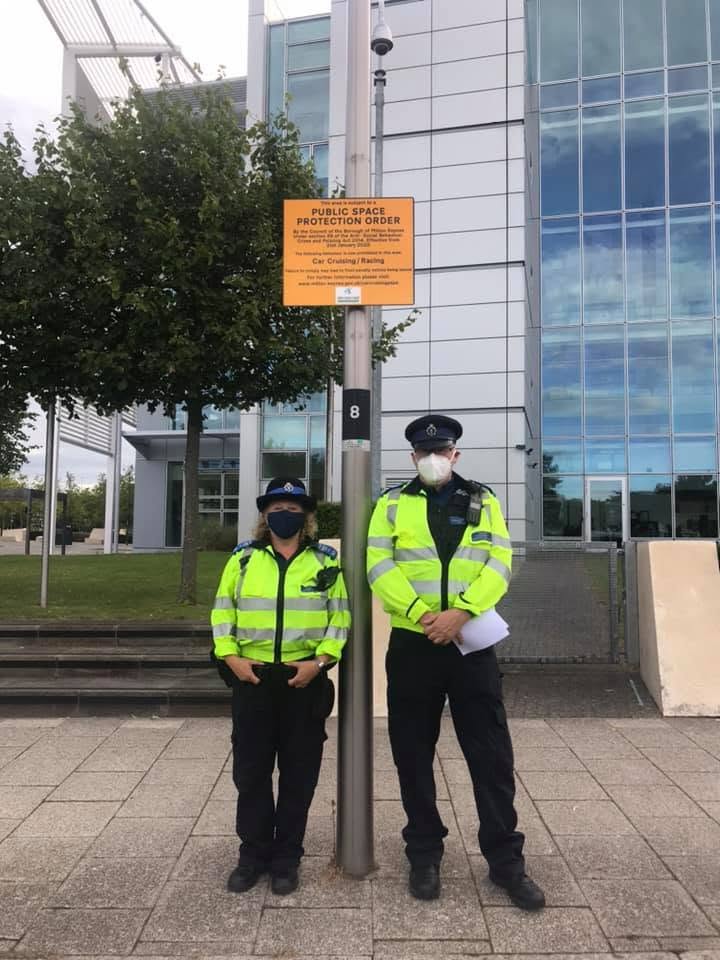
So I’m being warned for being near other people. The police accept that I have not done anything wrong. They accept that the activity I am supposedly participating in is not actually anti-social. The mechanism being deployed against me presumes my guilt because of my proximity to others, others whose specific identities and offences are never named in the letter, on dates when I was simply parked in a public car park.
The Network Rail cruise predates by decades the rules now being used against it. The cruise scene in Milton Keynes goes back to at least the 1990s, has moved location several times over the years (outside Comet, at the hockey stadium, and others), and has been at the Network Rail and Quadrant car park for many years now. It is one of a small number of continuously running unorganised cruises in the country, alongside places like Southend seafront. It has no organisers, no social media coordination, and no formal structure. It runs because people show up, in the same way they have done for decades. The car park itself, at the hour the cruise takes place, is one of the emptiest in central Milton Keynes. The cruise does not block, displace, or inconvenience any other use of the space, because at that time there is nobody else there. People who first came as teenagers in the 2000s are now bringing their own children along to look at the cars. It’s a hobby, in the end. The same kind of thing that gets photographers out before sunrise for the right light or has model railway enthusiasts arguing for hours about period-accurate signalling.
There is also a separate street racing scene in Milton Keynes. It does involve the behaviours the PSPO was originally introduced to address, such as racing, stunts, excessive revving and burnouts. It operates independently of the static cruise, moves around the grid roads through the night to stay ahead of the police, and has nothing much to do with the people standing in a car park looking at each other’s cars. The two have been collapsed into a single object of enforcement, and most people who don’t attend either won’t realise that’s happened. The distinction matters, because the activity actually being enforced against at Network is not the activity the PSPO was created to address.
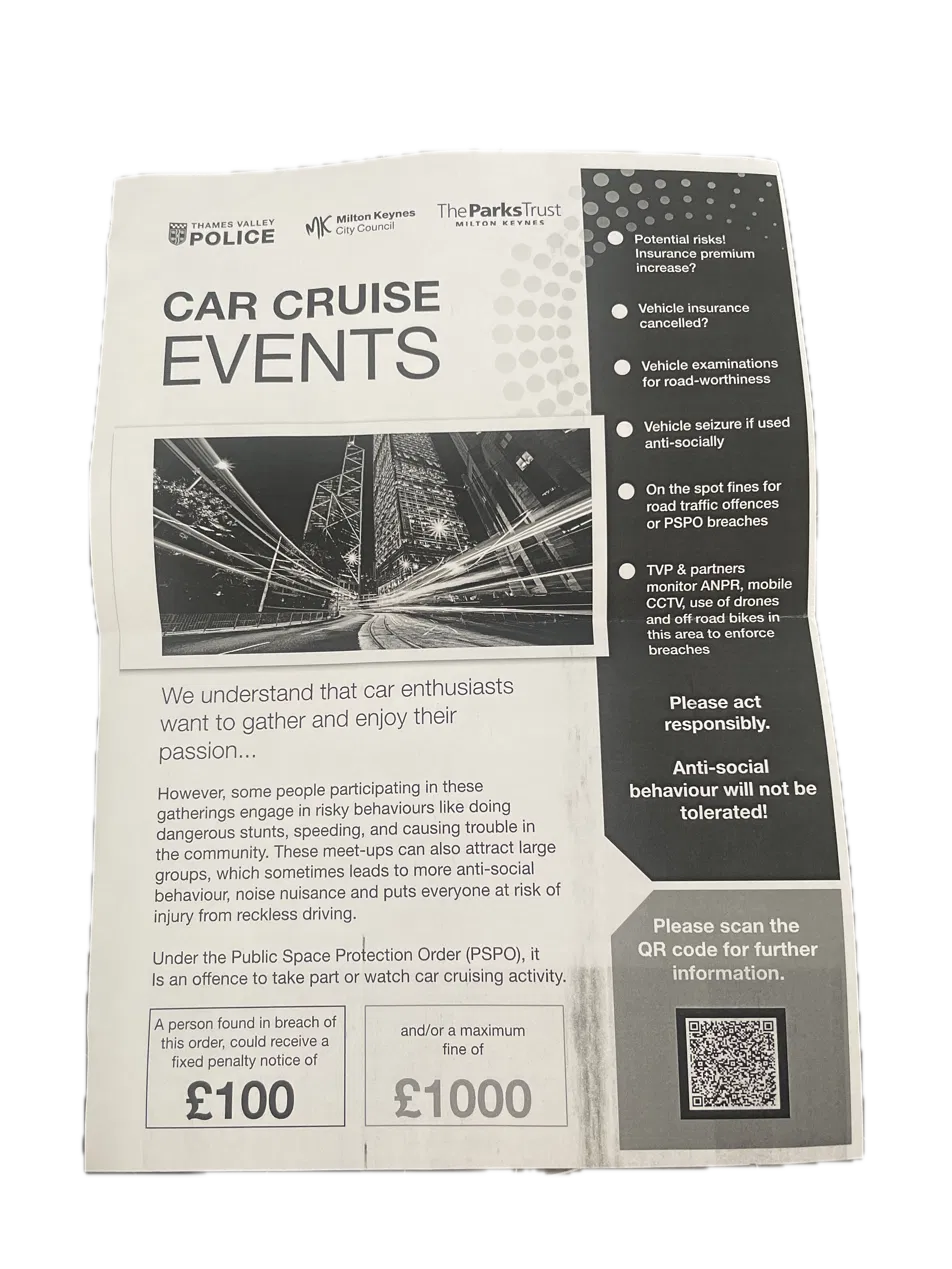
Over the last year, enforcement under the Vehicle Related Anti-Social Behaviour PSPO has been extended in practice to treat mere attendance of a car cruise as an offence, regardless of conduct. This was not the position the police were taking before. On 31 October 2024, before the current wave of enforcement, Thames Valley Police’s Chief Superintendent Emma Baillie was publicly quoted stating that she took ‘no issue with genuine car enthusiasts who want to come to Milton Keynes city centre and enjoy a hobby with friends and family’, with enforcement framed as targeted at people actually causing harm. Now, Thames Valley Police now issues warning letters to anyone whose number plate is logged by automatic number plate recognition cameras at the cruise site more than once. Some of the people who have received these letters had been to the cruise only a handful of times in months. A parent I’ve spoken to confirmed that some of his son’s logged ‘attendances’ were not attendances at all: they were drive-pasts on the public road near the car park, captured by the same cameras and treated as evidence of participation in something his son was not doing.
I’m not the only one unhappy with the template letter. A parent in Milton Keynes whose adult son received the same templated letter has written a formal complaint to Thames Valley Police. He has been ignored for over six weeks, despite providing the additional written consent the police demanded before they would engage with him. A mother in the local community has stopped taking her daughter to see the motorbikes at the cruise, because she was worried about being fined for pushing the buggy through. Another attendee who queried his warning letter was told, by an officer, that fines would only be issued for actual anti-social behaviour, despite the standing letter explicitly threatening fines for attendance alone. None of these people are isolated cases. The police themselves say ninety-six final warnings have gone out so far, with fines as the next step.
What is doing the work here is not the fine. Milton Keynes City Council’s own published figures show that only six Fixed Penalty Notices were issued under the Vehicle Related Anti-Social Behaviour PSPO in 2025 (seventeen across all of 2023, 2024 and 2025 combined). Compare that with ninety-six final warning letters in this year alone.
But even the warning letters are only part of it. The chilling effect on the community is the cumulative product of the standing letter, public Facebook posts from Thames Valley Police and Milton Keynes City Council about enforcement, verbal warnings issued at the site by officers, and word of mouth among the affected community about what has happened to others. Taken together, these communications have signalled to anyone who might attend that turning up at all, regardless of what they then do there, is now an enforcement risk. People have responded accordingly. They have stopped attending, stopped bringing their families, stopped using a public space they have used lawfully and peacefully for decades. The fine, when it appears at all, is the tail end of an enforcement strategy that is doing the bulk of its work upstream.
Last summer I watched a young man at the cruise receive a Section 59 warning, which is a separate police power (under the Police Reform Act 2002) that lets a vehicle be seized if used in a way causing alarm, distress or annoyance. The young man had the boot of his car open to show off a boot build, with the sound system inside playing music. The music wasn’t loud – you couldn’t hear it from thirty metres away. The car was his first. What he was doing was one of the most ordinary things in modified car culture: opening the boot to display a sound system he had put together himself, playing music through it at a sensible level. He was not given a warning before the Section 59 was issued; the Section 59 itself was apparently considered the warning. The Crime and Policing Act 2026 has now removed the requirement to issue a warning before seizure under section 59 of the Police Reform Act. When that provision comes into force, a vehicle can be seized on a first interaction with no warning at all. The person I watched receive that warning is still walking around with the knowledge that one more interaction with the police – whether fair or not – could lead to the loss of his car.
The car cruising community has been willing to engage. Someone in the local enthusiast community offered private land to nearby councils, where the cruise could continue under clear conditions and without the residential noise concerns that have driven some of the complaints. The offer was declined. The council position, as I have observed in my own correspondence with elected officials, appears to be that the cruise should not exist anywhere, rather than that it should exist somewhere it does not bother residents.
The affected community has announced a relocation to Tenpin, a car park on the other side of the road from the Network Rail and Quadrant site. The new location sits inside the same PSPO zone and is monitored by the same automatic number plate recognition cameras. It is a hundred-metre repositioning that the same enforcement will follow, against the same people, doing the same thing, on the same evening of the week. The relocation has not restored what was lost. Before, you would see hundreds of people at Network on a Sunday evening, a sprawling and happy community. Since the move, it is less than a hundred, sometimes less than forty. The community still exists, but it is waiting in the shadows for an outlet that it does not currently have. The activity itself is what is being targeted. And the activity itself, the police have already admitted in writing, is not anti-social.
I have raised most of the above with Thames Valley Police in correspondence. The Chief Superintendent has said, privately, that public communications clarifying the force’s stance would be issued shortly. Months have passed. Nothing has appeared. The most straightforward reading is that the current position, from the force’s point of view, is working. The community has fallen quiet, attendance has collapsed, and the pressure to say anything publicly is gone. That is not resolution. It is what a community looks like when it has been quietly removed from its own city, and it should worry anyone who cares about any other community the council or the police might one day decide it would be tidier to be without.
If you don’t own a modified vehicle and have never been to a car cruise, try this. Think about a hobby you actually enjoy. Picture the place you go to do it, and the people you usually see there. Now picture a letter from the police arriving at your home, telling you that you have been seen near other people doing this hobby more than once. The hobby itself is not a problem, the letter says, but doing it in the company of others has now become suspect. If you go back, you can be fined a hundred pounds. Picture the same letter telling you, in writing, that the police are not actually accusing you of anything.
I have not been accused of anti-social behaviour. Thames Valley Police have said so themselves, while threatening to fine me a thousand pounds.
The Public Spaces Protection Order regime in Milton Keynes has produced a position where being in public, near other people who like the same things you like, is enough to attract a formal warning, an enforcement record, and the threat of significant financial penalty. The letters are templated, the evidence base is automated. The PSPO and the way it is being enforced both need urgent review, so that law-abiding people are left free to pursue their hobbies. Without that, whichever hobby this mechanism is pointed at next, it will work the same way.